- Home Page /
- Books /
- Engineering & Transportation /
- Engineering /
- Mechanical /
- Machinery /
- Basic Machines and How They Work Revised 1994...


Item #:
2872270
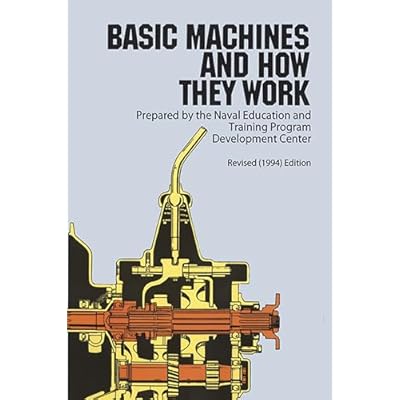
Basic Machines and How They Work Revised 1994 Edition
89% of respondents would recommend this to a friend
Item #:
2872270
€ 16
Price Details
Excluding Shipping & Custom charges ( Shipping and custom charges will be calculated on checkout )
*All items will import from US
0 ratings
Write a review
In stock
 Imported from USA store
QTY:
Order now and get it around Saturday, September 26
Secured transaction
Ubuy works hard to protect your security and privacy. Our advanced payment security system ensures confidentiality by encrypting your information during transmission using AES (Advanced Encryption Standards) and SSL (Secure Socket Layer) protocols. Your payment details are 100% secure as we do not share your payment details with third party sellers.
Our Top Logistics Partners


This revised edition of an extremely clear Navy training manual leaves nothing to be desired in its presentation.

Fast
Shipping

Free
Return*

Secure Packaging

100% Original Products

PCI DSS Compliance

ISO 27001 Certified



Note: Step Down Voltage Transformer required for using electronics products of US store (110-120). Recommended power converters Buy Now.


What Stands Out
Comprehensive Overview
Provides an in-depth understanding of basic machines, covering principles of mechanics and usage, making it ideal for students and enthusiasts seeking foundational knowledge in engineering concepts.
Updated Content
Revised edition offers modern examples and enhanced illustrations, making complex concepts more accessible while ensuring relevance in today's technological landscape.
Hands-On Learning
Encourages practical applications with experiments and projects, fostering a deeper engagement and everyday understanding of mechanical principles being taught.
Product Details
| Publisher | Dover Publications |
| Publication date | January 1, 1997 |
| Edition | Revised (1994) |
| Language | English |
| Print length | 128 pages |
| ISBN-10 | 0486217094 |
| ISBN-13 | 978-0486217093 |
| Item Weight | 8.8 ounces (249.48 grams) |
| Dimensions | 6.38 x 0.26 x 9.34 inches (16.2 x 0.7 x 23.7 cm) |
Who Should Buy?

-
Students of Physics
Ideal for students seeking foundational knowledge about basic machines and mechanical principles in physics education.
-
DIY Enthusiasts
Beneficial for hobbyists wanting to understand basic machinery for home projects and improvements.
-
Educators
Great resource for teachers needing clear explanations and visuals for lessons on machines and mechanics.

-
Advanced Engineers
Not suitable for professionals needing in-depth, complex engineering concepts beyond the basics of machines.
Product Description
Basic Machines and How They Work Revised 1994 Edition
Have any Query? Chat with us
Customer Questions & Answers
-
Question:
What types of basic machines are covered in 'Basic Machines and How They Work'?
Answer: The book explores six classical types of simple machines: lever, wheel and axle, pulley, inclined plane, screw, and wedge. Each machine is meticulously analyzed for its mechanical advantage and functionality. Understanding these machines provides foundational knowledge for both students and enthusiasts in physics and engineering. For example, learning about levers can assist in designing tools that amplify force, making tasks easier in everyday situations, from construction to simple home projects. -
Question:
How does the book explain the principles behind simple machines?
Answer: The book employs clear diagrams and practical examples to illustrate the principles of mechanical advantage. It breaks down complex concepts into digestible information, showing how the relationship between force, distance, and work influences machine efficiency. For instance, it details how the fulcrum in a lever affects the amount of force needed to lift a load. This approach makes the content accessible for educators and students alike, providing a strong foundation for further studies in mechanics. -
Question:
Is 'Basic Machines and How They Work' suitable for beginners?
Answer: Yes, this book is tailored for readers starting their journey into mechanical principles. It uses straightforward language and accessible explanations that demystify the workings of machines. Beginners will appreciate the step-by-step breakdown of each machine along with how they function in real-world scenarios. For example, understanding pulleys can help one grasp the mechanics behind construction cranes or gym equipment. -
Question:
Does the book include practical applications of simple machines?
Answer: Absolutely. 'Basic Machines and How They Work' illustrates how simple machines are integrated into everyday tools and technologies, enhancing comprehension of their practical significance. Each chapter often includes real-world examples, like how inclined planes facilitate moving heavy objects uphill. These insights allow readers to recognize the pervasive presence of these principles in various fields, from engineering to robotics. -
Question:
Can this book be used as a reference for engineering students?
Answer: Yes, it serves as an excellent reference for engineering students, detailing fundamental mechanics that underlie more complex concepts. The clarity of explanations along with visual aids makes it a valuable resource. Students can refer to it when learning about energy transfer, force applications, and machine calculations. Additionally, it prepares students to tackle advanced topics like mechanical systems or machinery design with a solid foundational understanding. -
Question:
What age group is 'Basic Machines and How They Work' appropriate for?
Answer: The book is accessible for a wide range of age groups, typically suitable for middle school students and older. Its engaging approach captures the interest of younger readers while also providing value to adults and educators looking for a reference. The scalable complexity of content ensures that it can cater to kids curious about science and adults seeking to refresh their knowledge on mechanics. -
Question:
What are some key illustrations found in the book?
Answer: The book features numerous annotated diagrams and illustrations that provide visual explanations of each machine's mechanics. These visuals are vital for understanding concepts like how a pulley system directs force or how a lever amplifies an input force. Visual learners will find these illustrations especially helpful, as they complement the text and clarify how these machines operate in various settings, from workshops to athletic fields. -
Question:
Does the book discuss the historical context of basic machines?
Answer: Yes, it delves into the historical development of simple machines, tracing their evolution and impact on civilization. Understanding the origins helps readers appreciate how ancient innovations laid the groundwork for modern technology. For instance, the evolution of the wheel from early cart systems to advanced transportation can enrich one’s perspective on engineering and design, showcasing the lasting influence of these basic machines. -
Question:
Are there any experiments or exercises included in the book?
Answer: Yes, the book includes practical exercises and thought-provoking questions that encourage readers to apply what they learn. Such activities can help reinforce understanding by allowing readers to experiment with basic machines in real-life contexts. For instance, an exercise might involve building a simple lever and calculating its mechanical advantage, promoting hands-on learning that deepens comprehension of theoretical principles. -
Question:
Where can I buy Basic Machines and How They Work Revised 1994 Edition?
Answer: You can purchase 'Basic Machines and How They Work Revised 1994 Edition' from Ubuy in Guadeloupe. Ubuy offers a convenient online shopping experience with a selection of books and educational materials, making it easy to find and obtain this resource wherever you are.
Machinery Editorial Review
The book serves as a good basic primer for understanding how machines work, their maintenance and problem-solving. The explanations are accurate and the illustrations are helpful. However, the book suffers from a detached front cover and poorly reproduced images.
Customer Reviews & Ratings
1 customers ratings
-
5 Star
100%
-
4 Star
0%
-
3 Star
0%
-
2 Star
0%
-
1 Star
0%
Review this product
Share your thoughts with other customers
Pros
- Accurate explanations
- Helpful illustrations
- Useful for understanding how machines work and fixing them
- Recommended for expanding knowledge of machinery
Cons
- Detached front cover
Platform Trust & Buyer Confidence

JK
Jasmin
Verified buyer
“Great products and very good service: very easy and very fast international delivery.”
9 September 2026 · via Trustpilot
AG
Anke
Verified buyer
“Wonderful online shopping experience, smooth transaction from the start. Payment method works conveniently and delivery is unexpectedly fast and reliable. You go the extra mile for service. What makes this even more amazing, you deliver to Namibia. I will remain a happy Ubuy customer and will increase my purchases for sure! Thank you!”
10 September 2026 · via Trustpilot
H
Hazel
Verified buyer
“Very easy to find the products what you need, and so fast delivery, that’s why I highly recommended to others costumers to used ubuy.”
10 September 2026 · via Trustpilot
O
Opaleye
Verified buyer
“I received exactly what I ordered I was skeptical about your site because that was my first time to order. But the order came timely and neatly packaged. I was not disappointed. Thank you.”
11 September 2026 · via Trustpilot
AC
Adele
Verified buyer
“Easy to find and order what you want on the website. Delivery is quick to the UK”
8 September 2026 · via Trustpilot
Secure Checkout
Global Delivery
Easy Returns
Genuine Products
Product Price History
Important information
- Limitations : For products shipped internationally, please note that any manufacturer warranty may not be valid; manufacturer service options may not be available; product manuals, instructions, and safety warnings may not be in destination country languages; the products (and accompanying materials) may not be designed in accordance with destination country standards, specifications, and labeling requirements; and the products may not conform to destination country voltage and other electrical standards (requiring use of an adapter or converter if appropriate). The recipient is responsible for assuring that the product can be lawfully imported to the destination country. When ordering from Ubuy or its affiliates, the recipient is the importer of record and must comply with all laws and regulations of the destination country.
- Not all the products listed on Ubuy are for sale, as Ubuy is a global search engine. Products are subject to export/trade regulations.
€ 16
Order now and get it around Saturday, September 26
This item is not restrict in my country.(Please click on above link if this item is not restrict in your country, So our team will review and allow.)
QTY:
Secured transaction
PCI DSS compliant and ISO 27001:2022 certified, with encrypted payments and full buyer protection on every order.
Our Top Logistics Partners
Fastest cross-border delivery
Features & Benefits
- Thorough in its coverage of basic theory from the lever to internal combustion engines and power trains
- Requires nothing more than an understanding of the most elementary mathematics
- Discussions of the block and tackle (pulleys and hoists), wheel and axle, the inclined plane and the wedge, the screw, and different types of gears
- Over 200 diagrams, drawings, and cross-sections that reveal inner workings
- Valuable to readers desiring basic knowledge of mechanics
- Can be used in standard technical schools as a basic text in mechanical engineering
Ubuy Assurance
Experience worry-free shopping with 100% original products, PCI DSS-compliant payment security, ISO 27001-certified data protection, the fastest cross-border delivery, free returns *, and secure packaging on every order.